A few pieces of relevant information:
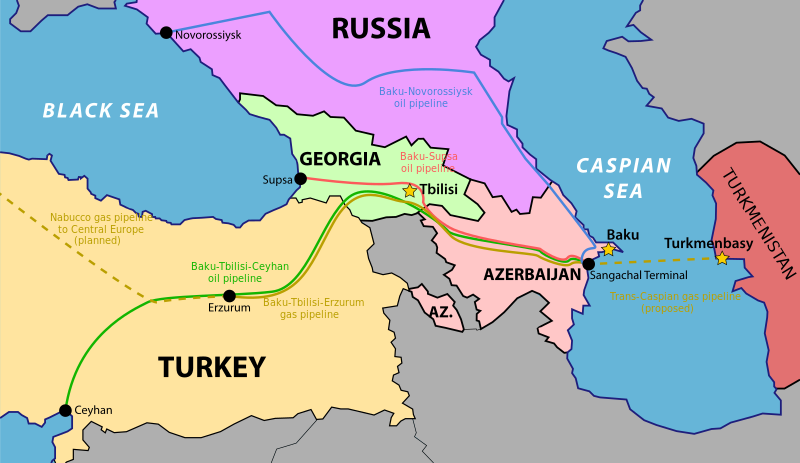
1) The Baku-Supsa Oil Pipeline
Owned and operated by British Petroleum, the pipeline has been online since 1999. It carries oil from the giant oil field under the Caspian Sea, across Azerbaijan and Georgia (running just south of South Ossetia), to the Black Sea, where it's taken by tanker ship across and through the strait of Bosporus into the Mediterranean, and from there out into the Atlantic and anywhere and everywhere in the world. Essentially, Russia can choke off a main route of Caspian oil distribution from South Ossetia.
2) The Baku-Novorossiysk Pipeline
The main pipeline moving Caspian oil into Russia itself. The government of Azerbaijan was so pissed at Russia in 2007 that they halted all oil delivery. It's still offline.
3) The Baku-Tblisi-Ceyhan Pipeline
A cooperative project between American and European oil companies and the government of Azerbaijan. Russia was completely left out. The pipeline went online in May of 2006. In 2005, Kommersant (the Russian Wall Street Journal) wrote:
"The only thing that could prevent the project from being finished is re-ignition of old ethnic conflicts in Karabakh, Abkhazia and South Osetia. These conflicts could directly threaten the pipe that is laying nearby. However, by now, the West has invested large amounts into the project and will not allow any risks. From now on, all games in the region will be played by new rules and will be linked to the Baku-Jeikhan axis. And the whole policy of the West will be directed to the pipeline protection."
Ah, hindsight. It's also worth pointing out that ALL of this oil flowing from the Caspian used to be owned by the Soviet Union.
4) What happened to North Ossetia?
Good story, actually. Ossetia was an "oblast", or province in the Soviet Union. When the USSR disintegrated, Ossetia was divided in half by the Russia-Georgia border. So North Ossetia is part of Russia now, and this is some part of Russia's interest in South Ossetia. Strategically, because unrest among the Ossetians in Georgia can easily spill over to the Ossetians in Russia. Conversely (and rhetorically), because Russia's "standing up for" the South Ossetians is domestically popular.
5) NATO
One whole chapter of Georgia's Foreign Policy Strategy for 2006-2009 was dedicated to the county's desire to join NATO. Yeah, NATO...the military alliance organized to counter-balance the Soviet Union, which has continued to grow and add member-states since the end of the Soviet Union. The addition of Ukraine and Georgia will push NATO's borders right up against Russia.
I suddenly want to play "Risk".


No comments:
Post a Comment